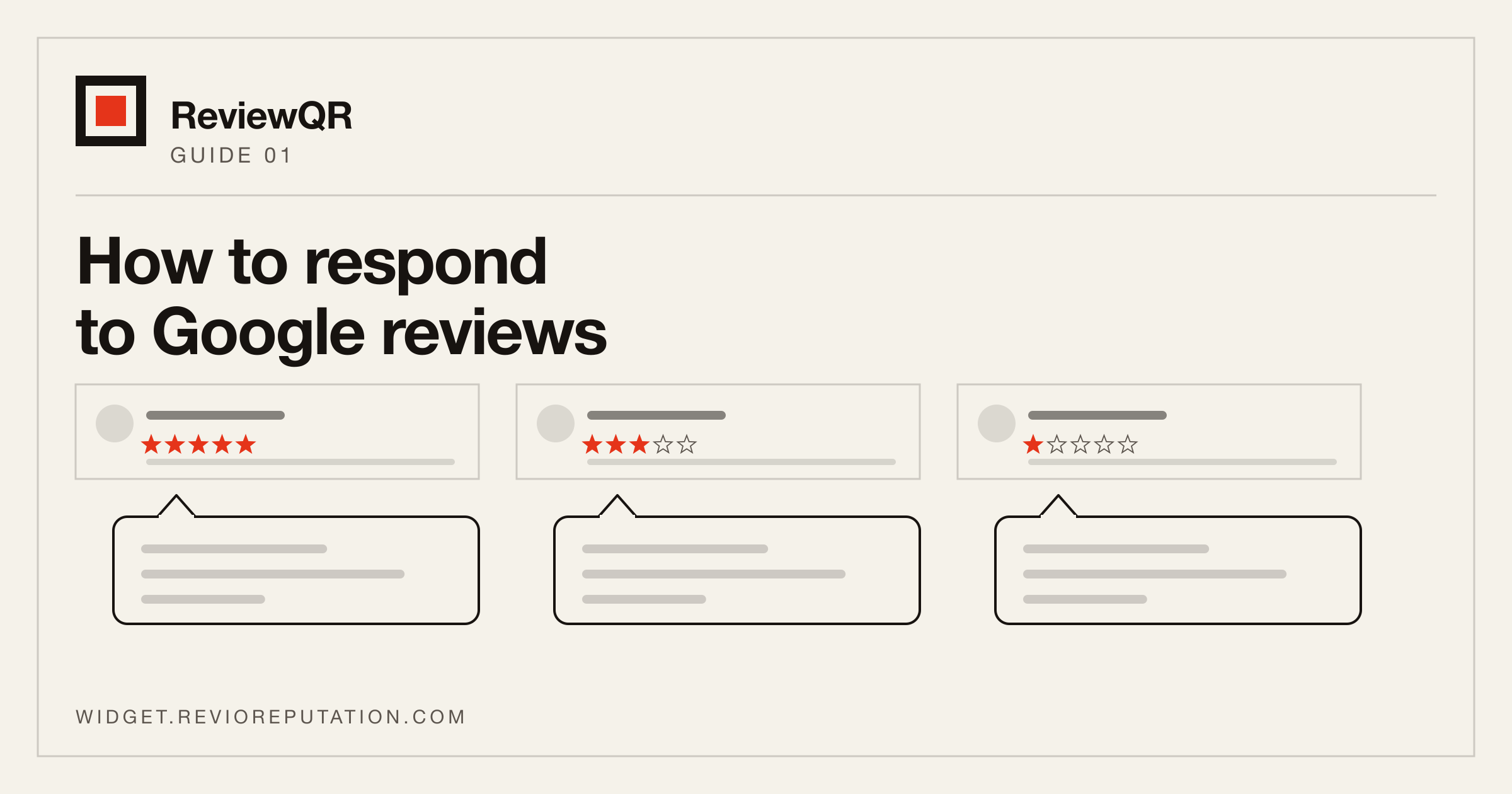
Why the reply matters more than the review
A review is written for the person reading it next. Your reply is too — and that reader is not the reviewer. Someone comparing three places at eleven at night scrolls past the stars and reads how you answered the two-star one. That is where they decide whether you are the kind of business that listens.
Google says as much in its own guidance to business owners: responding to reviews shows that you value your customers and their feedback. It does not promise a ranking boost for replying, and neither should anyone else. What a reply does is visible and checkable: it turns a one-sided listing into a conversation, and a listing with an owner in it reads as open for business.
Source: Google Business Profile Help, “Read & reply to reviews” — support.google.com/business/answer/3474050, read 23 September 2026.
The rule that covers every case
Reply to the person, not to the rating. A five-star reply that could be pasted under any review (“Thank you for your kind words!”) tells the next reader nothing, and a one-star reply written to win an argument tells them everything — about you. Before typing, find the one specific thing in the review: the dish, the staff member, the delay, the thing they noticed. Your reply is built around that detail. If there is no detail, the reply is short.
Two mechanical rules, both from the same reasoning. Reply in the language the review was written in — the next reader in that language is the one it is for. Never post anything about the reviewer that they did not post themselves: no booking details, no order history, no “as we discussed on the phone”. That is a privacy line, and it is also the fastest way to look like you are settling a score.
Five stars: say something back
The trap with a good review is that it feels finished. It is not; it is the easiest reply you will write and the one most owners skip. Three sentences, in this shape:
- Thank them by name, and name the thing they liked.
- Add one line they did not know — who made it, where it comes from, what is new.
- Invite them back to something specific.
“Thank you, Morgane — the print you took home was made by Audrey, and she was thrilled you noticed the detail on the toes. We do a second cast at six months for the same families; you know where we are.”
Notice what it does for the next reader: it repeats the praise in the owner’s voice, adds a fact, and mentions a return visit. That is three things a generic thank-you does not do.
Three stars: the review that tells you something
A three-star review is usually honest and usually specific. It is also the one the next reader trusts most, precisely because it is not gushing. Treat it as feedback with an audience:
- Thank them for the detail. Mean it.
- Say what you took from it. If you changed something, say so; if you will not, say why.
- Do not argue the star. Arguing with a three is how you earn a one.
“Thanks for the honest note, Karim. You are right that the wait on Saturday afternoon is too long — we have moved the second appointment slot earlier from next month to fix exactly that. Glad the result itself was what you hoped for.”
One star: the reply everyone else will read
This is the one that matters, and the one where the instinct is worst. The reply is not for the reviewer — they may never come back. It is for the two hundred people who will read it over the coming months and decide, from your tone alone, whether the complaint was a one-off.
- Wait an hour. Not a day — a visibly unanswered one-star review is its own message — but long enough that you are not typing the first thing you felt.
- Acknowledge the specific thing. Not “we are sorry you had a bad experience” — “you waited forty minutes and nobody told you why”. If the facts are wrong, state yours once, calmly, and stop.
- Say what changes, or what you would do now. One sentence. A plan is more convincing than an apology.
- Take it off the page. An email address or a name and a number. Not to hide the conversation, but because the next step needs details neither of you should post.
“Ana, you are right and I am sorry: the cast cracked in the drying rack and you were told a week later than you should have been. That is on us, not on you. I have remade it at no charge and it is ready now — write to me directly at the address on our site and I will bring it to you myself.”
What it never contains: an explanation of why the reviewer is wrong, anything about their behaviour, the word “but”, or an offer that reads as a bribe for changing the rating. Google’s content rules prohibit soliciting a review change in exchange for anything, and the next reader can tell.
The review you should report instead
Some reviews are not feedback: the one from a person who was never a customer, the one that names an employee to harass them, the one your competitor wrote. Do not reply to those in anger and do not reply to them at length. Reply once, briefly and factually — “we have no record of a visit under this name and would like to understand what happened” — and use Google’s report function. A short, calm reply under an obviously unfair review is the most persuasive thing on the page.
How fast, and how many
Every review, within a couple of days, in order. Not because a rule says so, but because the gap is what shows. A listing with thirty reviews and five replies tells the reader which twenty-five you did not think were worth it — and they will assume the bad ones. If you are starting with a backlog, work backwards from the newest: those are the ones being read.
The reply is the part of your listing you control completely. It costs three sentences and it is read by more people than your website.
Doing it without it becoming a job
The reason most listings go unanswered is not that owners disagree with any of the above. It is that the reviews arrive one at a time, in an app, on a Tuesday, and each one needs a decision. Two things reduce that to minutes a week: seeing every review in one place instead of hunting for the notification, and starting from a draft rather than a blank box.
ReviewQR collects reviews for your website and prints the QR code that asks for them. Answering them — with drafts written in the reviewer’s language, in your tone, for you to edit and publish — is the job of our full platform, RevioReputation. Either way, the three shapes above are the whole method; a tool only saves you the typing.